Short a · 10 words
CAT, HAT, MAT, BAG, MAP, CAP, FAN, JAM, BAT, TAP
Start with 12 × 12, Easy. Ask learners to sort -at words and other short-a words after the search.
Open this exact example →FROM FINDING TO REMEMBERING
Use a familiar word list, search for the spellings, then put the list away and try writing. Here is a practical routine with editable examples.
Pick 8–12 words from your current lesson. Read each one aloud and check its meaning. Keep one spelling pattern together when possible; combining unrelated difficult words can make it hard to see the pattern.
Ask the learner to find a word, circle its full spelling and say it. For beginners, choose Easy: words run across and down only. Diagonals change the search challenge, not the spelling lesson.
Cover both the grid and the word bank. Say three to five words aloud and ask the learner to write them on another sheet. Do not count finding a word as proof that they can spell it from memory.
Compare the written words with the list. Mark the part that needs attention, practise it, and check again later. Use your usual classroom assessment to decide what to teach next; this activity is not a reading or learning diagnostic.
CAT, HAT, MAT, BAG, MAP, CAP, FAN, JAM, BAT, TAP
Start with 12 × 12, Easy. Ask learners to sort -at words and other short-a words after the search.
Open this exact example →CAKE, MAKE, NAME, GAME, LATE, GATE, RAIN, TRAIN, DAY, PLAY
Start with 12 × 12, Easy. Sort the a-e, ai and ay spellings. These words share a sound but use different patterns.
Use this word list →ROOT, STEM, LEAF, SEED, SOIL, WATER, LIGHT, FLOWER, GROWTH, PLANT
Start with 12 × 12, Easy. Draw a plant and label its parts afterwards. Check meaning alongside spelling.
Use this word list →EASY · 12 × 12
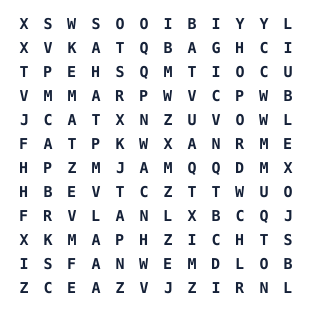
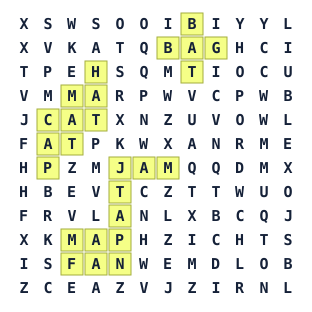
Ten three-letter words with a short-a sound. Use the puzzle as a recognition activity, then cover the list and check spelling separately.
Each PDF contains this exact puzzle on page one and its matching answer key on page two. Pick your paper size, then print only page one for players.
Free for classroom, event and personal use. No account, email or checkout.
A larger grid gives long words more room but also adds more letters to scan. For a first activity, use fewer short words and a 12 × 12 grid. Medium adds diagonals; Hard also adds backwards placements. Those settings are better chosen for search preference than as a label for a learner's ability.
Open the maker, select My own words, and enter one word per line. Use 3–30 different words with English letters. A word must fit within the selected grid size. Spaces and hyphens disappear inside the grid, so a phrase such as RAIN FOREST appears as RAINFOREST. Choose individual words when the purpose is spelling.
Preview the PDF before making a class set. Give the puzzle page to learners and keep the answer page for checking. Offer a shorter list, partner activity or another practice format if scanning a grid is not comfortable. Avoid treating completion speed as a measure of spelling skill.